
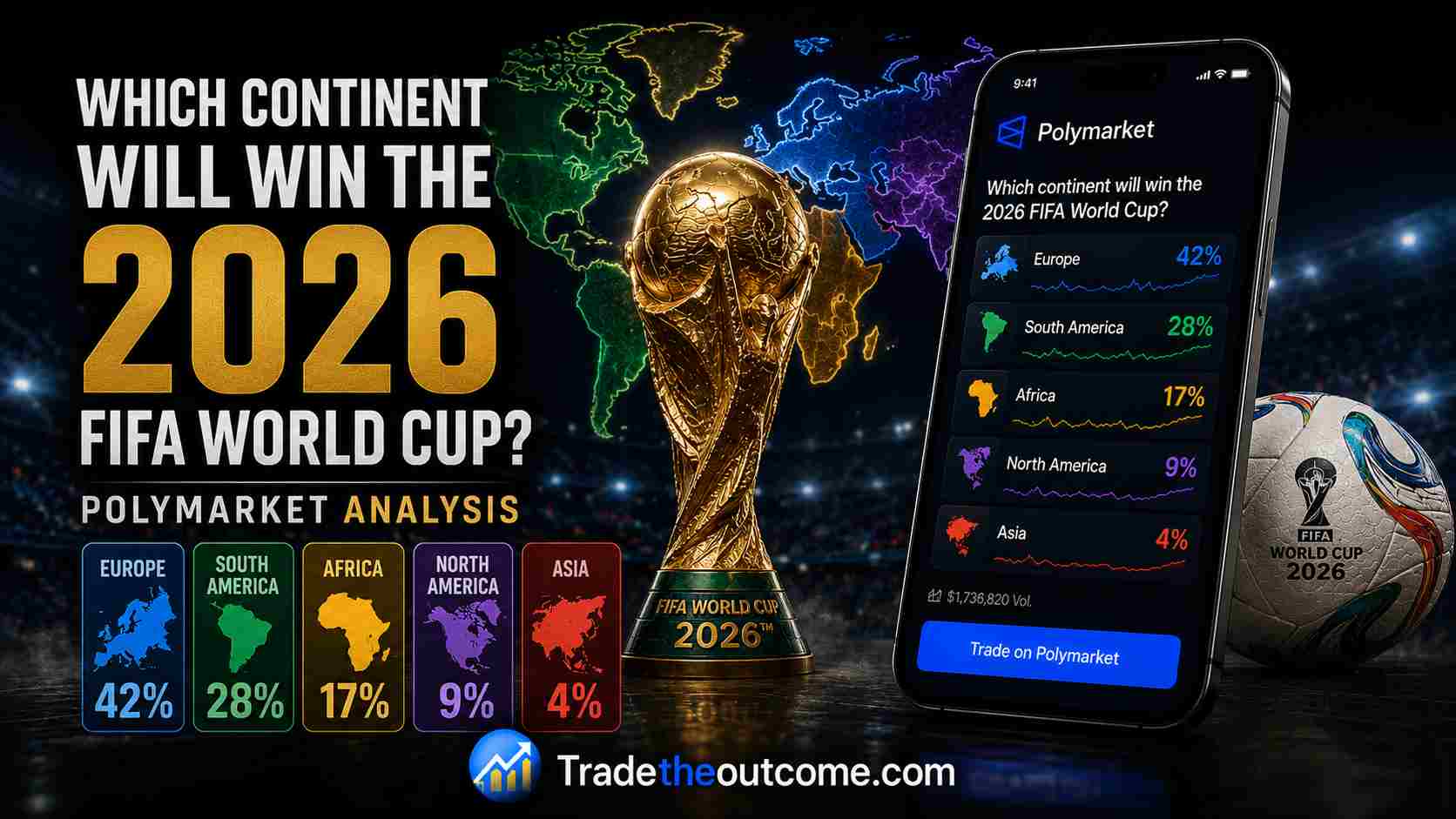
Europe at 72%. South America at 22%. The remaining 6% split across Africa, North America, Asia, and Oceania. On the surface, this looks straightforward. But the $2.46M in trading volume on this market, one of the highest in the entire FIFA World Cup 2026 cluster on Polymarket, has an unusual distribution hiding inside it.
Africa alone holds over $1M of that total at roughly 3% implied probability. Asia holds another $812K at under 3%. Together, those two continents account for nearly 74% of all trading while representing only 5% of the win probability. Understanding that dynamic is the most important thing you can do before taking a position in this market.
Which Continent Will Win the 2026 FIFA World Cup?
This market resolves to the continent of the World Cup winning nation. Europe leads at 72%, South America at 22%. Over $2.4M in total volume. Resolves July 19, 2026.
Disclosure: This link may be an affiliate link. I may earn a commission at no extra cost to you.
What the FIFA World Cup Continent Winner Market Means
This is a multi-outcome Polymarket contract that resolves to the continent of the winning nation. If Spain wins, it resolves to Europe. If Argentina wins, it will go to South America. Every team in the tournament maps to exactly one continental outcome, determined by the World Population Review rather than football federation membership. That classification distinction matters more than it might seem; more on that below.
The resolution source is official FIFA information, plus the World Population Review for continental classification. The market will be resolved by July 19, 2026, the date of the final. If the tournament is cancelled or not completed by December 31, 2026, the market resolves to “Other.”
Unlike the outright World Cup winner market where you back a specific team, this market aggregates all teams from each continent into a single position. Buying Europe YES at 72 cents pays $1.00 if any European team wins the tournament, not just one specific nation.
FIFA World Cup 2026 Continent Winner: Polymarket Market Data
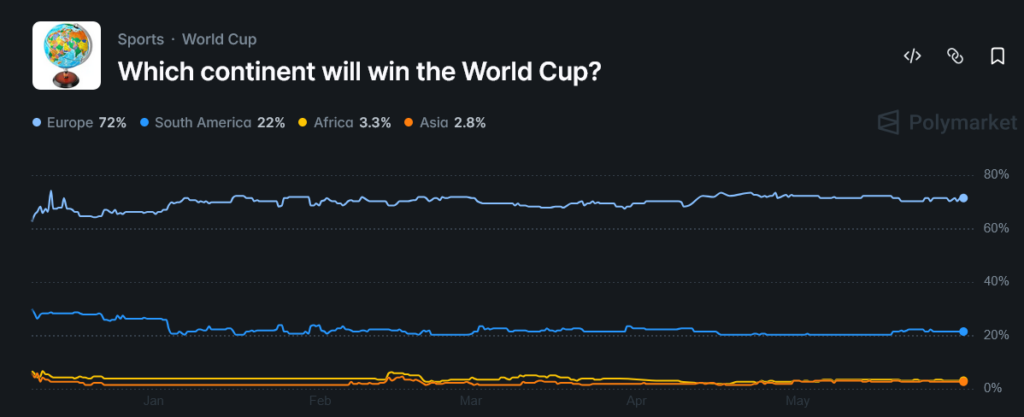
The Polymarket continent winner market opened on December 8, 2025, and has accumulated $2,463,353 in total volume across six continental outcomes.
Current probabilities by continent
| Continent | Implied Probability | Individual Volume | Recent Move |
|---|---|---|---|
| Europe (UEFA) | 72% | $331,649 | ↑1% |
| South America (CONMEBOL) | 22% | $264,444 | ↑1% |
| Africa (CAF) | 3.3% | $1,003,548 | ↑4% |
| Asia (AFC) | 2.6% | $812,168 | ↑3% |
| North America (CONCACAF) | 2% | $131,336 | stable |
| Oceania (OFC) | less than 1% | $444,775 | stable |
Volume and what it signals
Africa and Asia together hold $1,815,716 of the $2,463,353 total volume, representing 73.7% of all trading on just 5.9% of the combined implied probability. This is the most extreme NO-side arbitrage concentration in the entire FIFA World Cup 2026 Polymarket cluster.
Every group winner market showed this pattern at the individual team level. Here it appears at the continent scale, and the numbers are larger in absolute terms than any group market we have covered.
Africa at $1,003,548 with 3.3% implied probability means traders are buying NO on Africa at 96.8 cents, earning a near-certain return when no African team wins the World Cup. Asia at $812,168 at 2.6% runs the same trade at 93.2 cents. Oceania adds another $444,775 at 99.8 cents for NO on a sub-1% contract.
The volume figures that carry genuine market signals are Europe’s $331,649 and South America’s $264,444. Real YES buying on those two outcomes reflects active market positioning on the continent question. Everything else is yield-seeking capital deployed on near-certain NO positions.
Why Europe Leads the FIFA World Cup Continent Winner Market at 72%
The 72% figure is a mathematical product of two factors working together: the number of European teams in the tournament and the quality concentration among those teams.
The UEFA numerical advantage
16 of the 48 qualified teams are from UEFA, the largest single continental allocation. That is one-third of all teams in the tournament. Even if every European team had equal probability, 16 of 48 gives Europe a 33% baseline.
But the teams are not equal. Spain, France, England, Germany, Portugal, and the Netherlands all sit in the top eight of the outright winner market. When you aggregate the individual win probabilities of all European teams, the total lands at approximately 72-74%, which is precisely what the continent market is pricing.
The top-ranked Europeans
The outright winner market has Spain and France co-favourites at 17% each, England at 14%, Germany at 9%, Portugal at 8%, and the Netherlands at 7%. Those six teams alone total 72%. Add Scotland, Austria, Belgium, Croatia, Switzerland, Sweden, Norway, Türkiye, Bosnia, and Czechia, and you get the full European allocation. Spain in Group H, France in Group I, and England in Group L all represent strong individual tournament paths that collectively sustain the 72% continent probability.
The Türkiye classification edge case
One important detail is buried in the market rules. The World Population Review, the definitive source for continental classification in this market, classifies Türkiye as part of Asia, not Europe, despite Türkiye qualifying via UEFA and playing in European competitions. The market rules link directly to the World Population Review’s Turkey page to confirm this. If Türkiye were to win the 2026 World Cup, this market would shift to Asia, not Europe.
Türkiye are 36% to win Group D on Polymarket and a legitimate tournament participant. The effect on probabilities is small but real. Traders who buy Europe YES are not getting Türkiye’s win probability included in their position. Asia YES holders get that upside instead. At 2.6% implied probability for Asia, the Türkiye factor is one of the reasons that the price is not zero.
South America at 22%: Argentina, Brazil and the CONMEBOL counterweight
South America’s 22% is almost entirely Argentina and Brazil. The outright winner market has Argentina at 9% and Brazil at 12%. Those two teams alone account for 21% of the combined tournament probability. Uruguay, Colombia, Ecuador, and Paraguay add fractional upside that rounds the total to approximately 22%. The continental market is pricing South American representation accurately because CONMEBOL sends only six teams compared to UEFA’s 16.
South America has won 10 of the 22 previous World Cups. Brazil have five titles, Argentina three, Uruguay two. At this tournament, Argentina are the only defending champion and arrives with Messi confirmed in the squad. Brazil carry the Neymar fitness question through their Group C campaign. The crowd is not dismissing South America, but 22% accurately reflects that CONMEBOL’s upside is concentrated in two teams rather than distributed across six.
Africa, North America, Asia, and Oceania: what the small probabilities mean
No World Cup has ever been won by a nation outside Europe or South America. England won in 1966, and every other champion has been from one of those two continents. Africa, Asia, North America, and Oceania have never produced a World Cup winner across the tournament’s 22 editions.
Africa’s 3.3% is driven primarily by Morocco, which reached the semi-finals at Qatar 2022. Senegal, Ghana, Côte d’Ivoire, and Tunisia provide additional African tournament presence. At 3.3%, the market is saying an African nation wins the World Cup roughly once in 30 equivalent tournaments. If Morocco’s defensive system under new coach Mohamed Ouahbi carries over from the Qatar 2022 blueprint, the 3.3% is the market’s honest assessment of their ceiling.
North America’s 2% reflects the co-host factor. The USA at 38% to win Group D, Mexico at 52% in Group A, and Canada at 30% in Group B are all competitive group stage participants. A deep run by any of the three would move the North America price significantly from 2 cents. The tournament history weighs against them, but the co-host advantage is real across group stage fixtures.
Your Polymarket Trading Strategy for the Continent Winner Market
Europe YES at 72¢ is a capital deployment trade rather than a speculative bet. You risk 72 cents to profit 28 cents for a 39% return if any European team wins the tournament. The market prices this at 72% probability. The key question is whether that number is correctly aggregated. Given that Spain, France, England, and Germany alone sum to over 57% in the winner market, 72% for all of Europe combined looks accurately priced rather than inflated.
South America YES at 22¢ is the value trade for traders who believe Argentina or Brazil are underpriced in the outright winner market. If you think Brazil at 12% is too low for a five-time champion with Vinicius, Raphinha, and Neymar in the squad, buying South America at 22 cents captures that thesis without committing to a specific team. A Brazil win or an Argentina win both resolve South America YES at $1.00.
Africa YES at 3.3¢ is the highest-payout long shot in the market. Morocco’s Qatar 2022 semi-final run remains the strongest African performance in World Cup history. If you believe Morocco or Senegal can replicate or exceed that campaign in 2026, this is where that view is expressed at roughly 30x return on stake.
Asia YES at 2.6¢ has a specific edge case worth noting. If Türkiye, who are 36% to win Group D, runs deep into the knockout stage, this contract benefits directly. The crowd buying Asia NO at 93.2 cents is treating Asia as a near-certain arb. A strong Türkiye tournament run would disrupt that consensus significantly.
For the full context of how individual teams contribute to these continent probabilities, the Polymarket FIFA World Cup 2026 hub covers every active group winner, player, and match market in the cluster.
Frequently Asked Questions — Continent Winner Market at FIFA World Cup 2026
How does the continent winner market resolve?
The market resolves to the continent of the team that wins the 2026 FIFA World Cup. The continent is determined by the World Population Review, not by football federation membership. If Spain wins, it resolves to Europe. If Argentina wins, it will go to South America. The resolution source is official FIFA information. The market resolves by July 19, 2026.
Why does Europe lead at 72%?
Europe has 16 of the 48 qualified teams, the largest single continental allocation. Among those are Spain, France, England, Germany, Portugal, and the Netherlands, all in the top eight of the outright winner market. Aggregating the individual win probabilities of all European teams totals approximately 72%.
What does South America’s 22% represent?
South America’s 22% is almost entirely Argentina at 9% and Brazil at 12% from the outright winner market, with Uruguay, Colombia, Ecuador, and Paraguay contributing the remainder. CONMEBOL qualifies only six teams compared to UEFA’s 16, so the continent probability is concentrated rather than distributed.
Why does Türkiye count as Asia in this market?
The World Population Review, the definitive classification source specified in the market rules, places Türkiye in Asia geographically despite Türkiye qualifying via UEFA and competing in European football competitions. If Türkiye wins the World Cup, this market resolves to Asia, not Europe. The market rules link directly to the World Population Review’s Turkey page to confirm this classification.
Why do Africa and Asia have more trading volume than Europe despite much lower probability?
Africa’s $1,003,548 and Asia’s $812,168 in volume is almost entirely traders buying NO contracts at 96.8 cents and 93.2 cents, respectively, earning near-certain returns when those continents fail to produce a winner. It is yield-seeking behaviour on idle capital. The pattern is consistent with the NO-side arbitrage seen across every group winner market in the cluster, but at significantly larger absolute dollar amounts.
Has a non-European, non-South American team ever won the World Cup?
No. Every World Cup winner since 1930 has been from Europe or South America. Africa, Asia, North America, and Oceania have never produced a World Cup winner across 22 tournaments. The 6% combined probability for those four continents represents genuine uncertainty about whether 2026 could produce historical change, not any specific team assessment.
