

Polymarket Perps is a perpetual futures product that lets traders go long or short on assets like Bitcoin, gold, and individual equities with leverage, settling continuously through a funding rate instead of resolving to a fixed $1 or $0 payout. Unlike Polymarket’s core prediction market shares, Perps positions never expire and can be closed at any time.
Polymarket announced the product on April 21, 2026, timing the launch just ahead of rival Kalshi’s own perpetual futures rollout, as CNBC reported. As of August 2026, Perps remains in early access, opened in waves to traders who hold a referral or invite code rather than being available to every Polymarket account. The product is a meaningful departure from how Polymarket has worked since 2020.
Where a standard Polymarket share settles once an event resolves, a Perps position tracks a live index price indefinitely, which means the mechanics that matter- funding, margin, and liquidation- borrow directly from crypto exchanges like Hyperliquid and dYdX rather than from Polymarket’s own order-book history.
Polymarket Perps Explained for Beginners
Learn how Polymarket Perps work, how perpetual markets differ from traditional prediction markets, and how traders can use leverage, market pricing, and position management to express a view on crypto markets. This beginner-friendly guide breaks down the basics before you trade.
Disclosure: This link may be an affiliate link. I may earn a commission at no extra cost to you.
Table of Contents
What is Polymarket Perps?
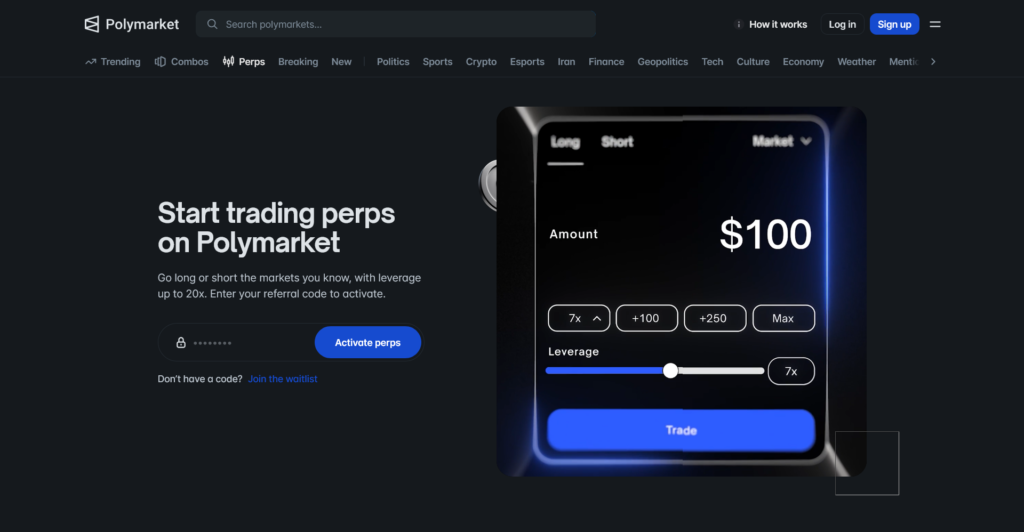
Polymarket Perps is a perpetual futures exchange offering continuous exposure to equities, indices, commodities, and other underlyings, according to Polymarket’s own Perps documentation. A Perps trade starts as an order in the order book, and once it fills it becomes a position whose value tracks the underlying asset until the trader closes it or the system force-closes it through liquidation.
This is structurally different from a traditional futures contract, which has a fixed expiry date and converges to the spot price at settlement. A perpetual future never expires. Instead, it uses periodic funding payments between long and short position holders to keep the contract price close to the asset it tracks, which is the same mechanism that has powered crypto perpetuals on exchanges like Hyperliquid and dYdX for years, now applied inside Polymarket’s own order book.
Perps versus perpetual futures elsewhere in crypto
The term “perps” is trader shorthand for perpetual futures generally, and Polymarket’s implementation follows the same core design as the rest of the category: no expiry, funding-based price anchoring, and leveraged margin trading.
What differs is the venue and the asset roster. Polymarket Perps currently list underlyings such as Bitcoin, gold, and Nvidia stock, settled in pUSD, Polymarket’s collateral asset, rather than the broader token universe available on a dedicated crypto derivatives exchange.
How Perps differ from Polymarket’s prediction market shares
A standard Polymarket share is a binary bet. A trader buys a Yes or No share priced between $0 and $1, and the price reflects the market’s live probability estimate for that outcome. When the underlying event resolves, the share pays out $1 or $0 and the position closes automatically. Perps abandon that structure entirely in favor of continuous, leveraged exposure to a tracked asset price.
| Feature | Polymarket shares | Polymarket Perps |
|---|---|---|
| Settlement | Resolves to $1 or $0 at a fixed event outcome | No expiry; stays open until closed or liquidated |
| What it tracks | The market’s implied probability of a real-world event | The live index price of an asset like Bitcoin or gold |
| Leverage | None; a share costs its full price to hold | Leverage tiers apply, capped per market |
| Maximum loss | Limited to the amount paid for the shares | Can exceed initial margin if the position is not closed before liquidation |
| Collateral asset | USDC | pUSD |
The practical effect is that a share is a bet with a known, bounded downside and a fixed resolution date, while a Perps position is an open-ended trade whose risk depends entirely on how the trader manages leverage and margin. Readers newer to the underlying platform may want the foundational explainer on how Polymarket works before layering Perps mechanics on top of it.
How leverage, margin, and liquidation work together
Every Perps position is backed by collateral, which Polymarket calls margin. The amount of margin required to open a position, the initial margin, depends on the leverage setting a trader selects and the leverage tier available for that instrument. Leverage tiers cap the maximum leverage as a position’s notional value grows, so building a larger position requires lowering leverage rather than scaling the cap linearly.
Maintenance margin works differently. It is a flat rate per market, calculated as half the initial margin rate at that market’s maximum leverage, according to Polymarket’s Perps FAQ documentation.
A market with 20x maximum leverage carries a 2.5% maintenance margin rate. In practice, a trader who opens a $10,000 notional position with $500 of margin at 20x leverage gets liquidated once losses erode account equity down to roughly $250, about half of the original margin, not the moment the position moves against them at all.
- Isolated margin funds a single position with a dedicated collateral allocation, so liquidation only closes that one position.
- Cross margin shares collateral across every cross position in the account, which lets unrealized gains on one position offset losses on another, but a liquidation event can unwind the whole cross account at once.
- The web app opens new Perps positions in isolated margin mode by default; switching to cross margin currently requires configuring leverage through the API rather than a toggle in the trading interface.
Liquidation itself runs on account equity, not the last traded price. Equity is calculated as collateral plus unrealized profit or loss, minus amounts owed, and it is checked continuously against the maintenance margin threshold. Once equity falls below that threshold, the system closes the position with reduce-only orders rather than waiting for the trader to act.
How funding payments keep the contract anchored to price
A perpetual contract has no expiry to force its price back toward the underlying asset, so funding payments do that job instead. When the Perps contract trades above its index price, long position holders pay short holders. When it trades below, the payment flows the other way. Polymarket takes no cut of this payment; it moves entirely between traders.
The calculation is more granular than the “settles every eight hours” shorthand commonly used to describe crypto perpetuals. Polymarket samples a premium index every five seconds by walking the order book for a fixed notional on each side, averages those samples over a one-hour charge window, and runs the result through an eight-hour rate formula that is then divided by eight and capped at plus or minus 4% per hour.
Settlement happens once per one-hour window rather than once every eight hours, which means funding costs or credits accrue and settle into account equity more frequently than many traders coming from other perpetuals venues expect.
This matters for position sizing. A trader holding a leveraged position for days or weeks is paying or receiving funding on every settlement window, and in a market with a persistent premium, that cost compounds. A short-term directional trade is far less exposed to funding drag than a multi-day carry position, which is one reason the product suits different use cases than Polymarket’s resolution-based shares.
The risks and who Perps actually suit
Leverage is the central risk, and it cuts in both directions by construction. A position that gains 10% at 10x leverage returns roughly 100% on the posted margin, and a position that loses the same 10% can trigger liquidation well before the loss reaches that size, depending on the market’s maintenance margin rate.
Polymarket’s own documentation is explicit that liquidation is a forced closure, not a stop-loss the trader controls, and that an insurance fund only steps in once equity falls to two-thirds of maintenance margin, after which the system absorbs the position directly rather than relying on the order book to unwind it cleanly.
A second risk is jurisdictional. Order placement on Perps is not permitted from the United States, Canada, Cuba, Iran, North Korea, Syria, Crimea, Donetsk, or Luhansk, per Polymarket’s own FAQ. This is a meaningfully different access model from Polymarket’s prediction market shares, where a CFTC-regulated US entity now serves American traders directly. Perps, at least in its current early-access form, does not extend that regulated pathway, and traders should not assume the two products share the same jurisdictional footing.
The product also carries the ordinary immaturity risk of any early-access derivatives venue. Fee tiers, leverage caps, and the instrument roster are all subject to change as Polymarket scales the product past its initial rollout, and thin liquidity on newer instruments can widen the gap between a trader’s intended entry price and the price they actually get filled at.
Traders considering Perps as a hedge against an existing share position, or as a way to trade short-term price moves without waiting for an event to resolve, are the closest fit for what the product is built to do. Casual bettors accustomed to Polymarket’s bounded-downside shares are taking on a fundamentally different risk profile the moment they add leverage.
What matters most for traders considering Perps
Perps is not a leveraged wrapper around Polymarket’s existing political and cultural markets. It is a separate derivatives product tracking asset prices like Bitcoin, gold, and individual equities, built on the same funding-rate mechanics that govern every other perpetual futures exchange in crypto.
Traders who already understand margin, liquidation, and funding from platforms like Hyperliquid or dYdX will recognize the shape of the product immediately; traders coming from Polymarket’s shares should treat it as a new instrument rather than an extension of the one they already know.
Anyone weighing whether to request access should read the fee schedule and margin documentation directly before sizing a first position, since tiers and caps are still evolving during early access. For traders comparing how this fits into a broader approach to the platform, Polymarket’s 2026 strategy guide and the standalone breakdown of Polymarket’s share-trading fee structure cover the mechanics that still govern the majority of activity on the platform.
Frequently Asked Questions
A few questions come up repeatedly once traders understand the basic mechanics of the product.
How do Polymarket Perps differ from Polymarket’s prediction market shares?
Shares resolve to $1 or $0 when a real-world event concludes and carry no leverage, while Perps track a live asset price with no expiry and can be traded with leverage. A share’s maximum loss is bounded by its purchase price; a Perps position can be liquidated if losses erode margin below the maintenance threshold.
How much leverage can I use on Polymarket Perps?
Leverage caps are set per instrument and decline as a position’s notional value grows, with some markets allowing up to 20x at smaller sizes. The maintenance margin rate scales with the market’s maximum leverage, so higher-leverage markets carry tighter liquidation buffers.
How do I get access to Polymarket Perps?
Perps requires a referral or invite code during its current early-access rollout rather than being open to every Polymarket account. The same code that grants a new trader access also attributes that trader to the referrer for revenue-sharing purposes under Polymarket’s Perps referral program.
Are Polymarket Perps available in the United States?
No. Order placement on Perps is blocked from the United States, Canada, and several other restricted jurisdictions, which is a different access model than Polymarket’s CFTC-regulated prediction market shares available to US traders. Traders should not assume the two products carry the same regulatory status.
