
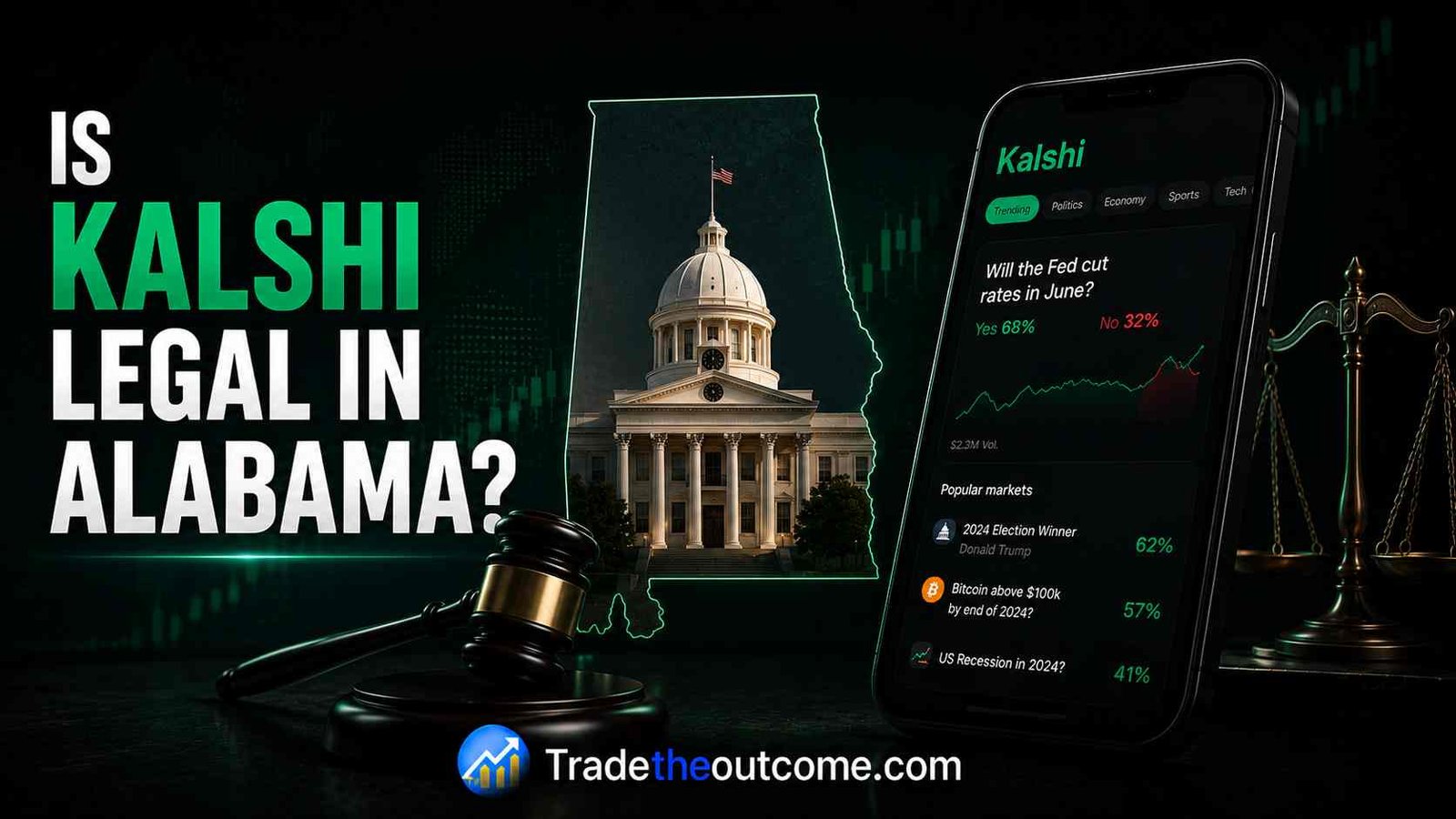
Yes, Kalshi is legal in Alabama. The platform operates as a federally regulated Designated Contract Market (DCM) under the Commodity Futures Trading Commission (CFTC), and that federal license applies nationwide, including in Alabama, which has some of the strictest anti-gambling laws in the United States.
This means you can legally trade prediction markets on Kalshi in Alabama the same way you would in California or New York, despite Alabama banning traditional sports betting.
However, as of July 2026, Alabama’s legal status is more complicated than it appears. The state is actively challenging Kalshi’s legal presence in the courts, creating real enforcement risk that Alabama residents should understand before signing up.
A class action lawsuit filed in January 2026 alleges that Kalshi has operated illegally in Alabama for years. While the lawsuit has not yet succeeded, it reflects the state’s increasingly hostile stance toward prediction markets and the gap between federal permission and state enforcement.
Federal Legal Status vs. State Enforcement
Kalshi’s legal position rests on its CFTC designation as a DCM. This classification is federal and blanket, covering all 50 states without state-by-state licensing. Unlike traditional sportsbooks, which require separate gaming licenses in each state where they operate, Kalshi trades event-based derivative contracts that the CFTC supervises as financial instruments, not gambling. This regulatory distinction is the reason Kalshi is available in states that ban sports betting entirely.
The problem for Alabama traders is that the state disagrees with this framing. Alabama law treats prediction markets on sports outcomes as illegal wagering, regardless of how the CFTC classifies them.
In January 2026, Christopher Jennings, an Alabama resident, filed a class action lawsuit in federal court alleging that Kalshi has operated illegally under Alabama’s strict anti-gambling statutes and is liable for damages under Alabama’s Loss Recovery Statute. The lawsuit also seeks a permanent injunction to block Kalshi from offering its services to Alabama residents.
The Litigation Risk
As of now, the Jennings lawsuit has not been decided, and no court has ruled that Kalshi must leave Alabama or block Alabama residents. iGamingToday reported in February 2026 that Kalshi is fighting the case, and similar prediction-market lawsuits in other circuits have not yet succeeded.
That said, Alabama has a history of aggressively suing gambling operators, including more than 40 lawsuits against sweepstakes casinos. The state’s willingness to pursue litigation creates uncertainty about whether Kalshi will remain accessible to Alabama users long-term.
The Jennings case is the first prediction-market lawsuit filed in Alabama, making it a test case for the state’s enforcement strategy. If Alabama courts side with Jennings, they could order Kalshi to geofence Alabama residents, similar to what has happened in other states like Massachusetts. Until the court rules, Alabama traders occupy a gray zone: they are legally allowed under federal law but potentially vulnerable under state law.
What This Means if You Trade in Alabama
From a practical standpoint, Alabama traders can sign up for Kalshi today and begin trading event contracts. The platform does not block Alabama IP addresses, and Kalshi’s documentation explicitly lists Alabama as a supported state.
You satisfy the basic legal requirement: trading on a federally regulated DCM is legal at the federal level, and the CFTC has jurisdiction over Kalshi’s operations.
However, you should be aware of the enforcement risk. If Alabama wins the Jennings lawsuit, Kalshi could be forced to restrict or terminate service to Alabama residents. If you have accumulated contract holdings or unwithdrawable balances on the platform, a sudden block could complicate your exit.
Additionally, Alabama’s aggressive stance on gambling enforcement suggests that the state may pursue additional legal action against Kalshi or its users. While there is no evidence that Kalshi has cooperated with Alabama authorities to identify or pursue traders, the state’s history of sweepstakes-casino litigation shows it will move against platforms it deems illegal.
For more context on how Kalshi compares to other prediction markets on liquidity and regulatory standing, see our full Polymarket-Kalshi liquidity comparison. For a detailed explanation of what makes Kalshi legitimate at the federal level, read our explainer on whether Kalshi is a legitimate trading platform.
