

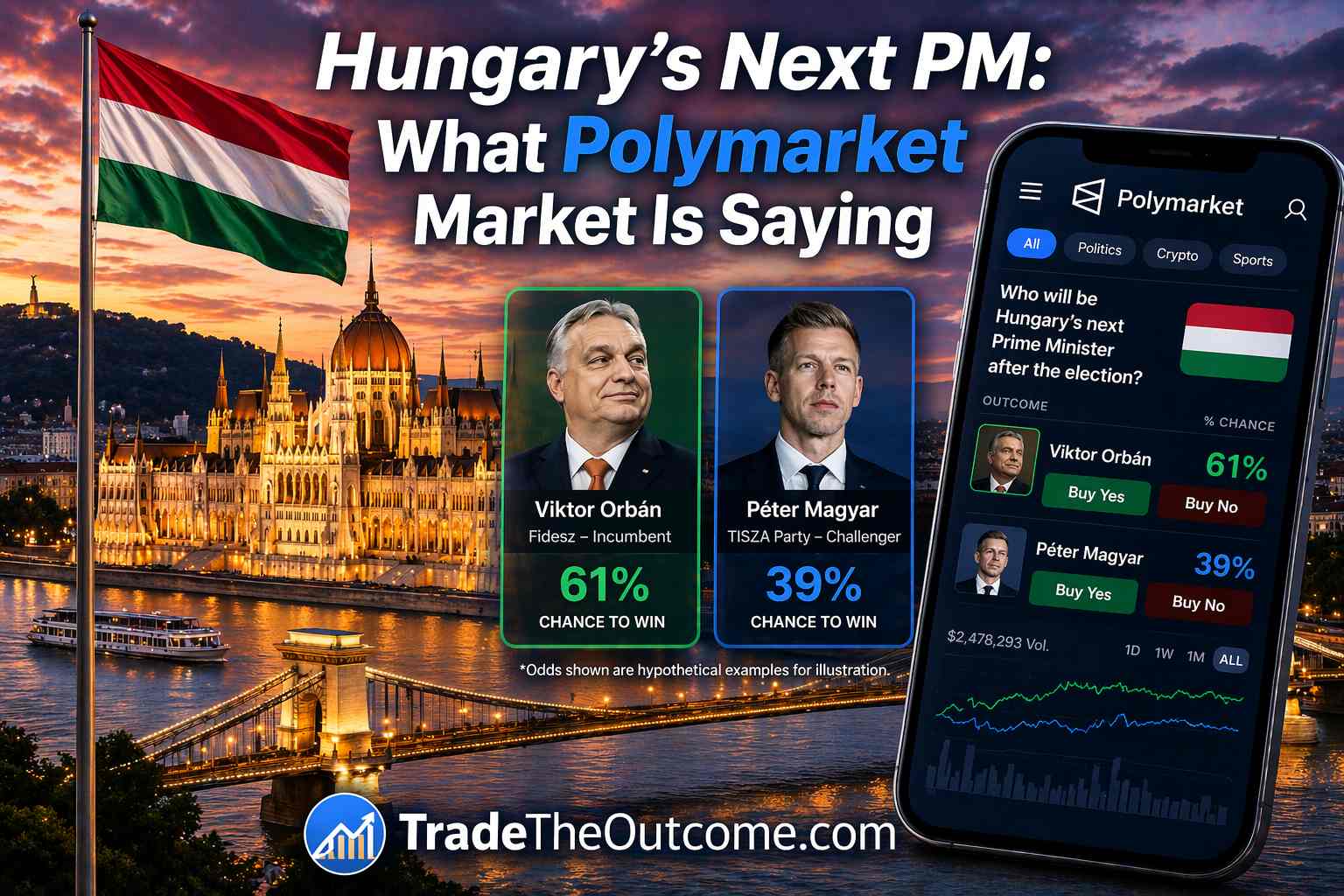
Hungary votes on April 12, 2026, and the prediction market crowd has already delivered a verdict. On Polymarket, opposition leader Péter Magyar is priced at a 71% chance of becoming the country’s next prime minister.
This analysis unpacks what that number means, what the polls say, and what a new trader should think about before touching this market.
Hungary Election: Can Orbán Survive?
Polymarket currently prices Viktor Orbán as a strong favorite to remain Hungary’s prime minister, with odds around 71%. Traders are factoring in political dominance, opposition fragmentation, and election dynamics as they assess whether this lead holds or weakens over time.
Disclosure: This link may be an affiliate link. I may earn a commission at no extra cost to you.
What Is This Market, and How Does It Work?
The market asks one question: who will be Hungary’s next officially appointed and confirmed prime minister following the April 12 parliamentary election? If you are new to this type of market, start with our guide on prediction markets before reading further.
The market resolves to the name of the person formally confirmed as prime minister by the Hungarian National Assembly. An interim or caretaker prime minister does not count toward resolution. If no one is confirmed by December 31, 2026 at 11:59 PM ET, the market resolves to “Other.”
What YES and NO Shares Mean
Every candidate has their own YES and NO market. Buying a YES share on Péter Magyar at 7 cents means you earn $1 if he becomes prime minister and lose your 7 cents if he does not. The price of a YES share equals the market’s implied probability directly.
Magyar’s YES share at 7 cents = 71% implied probability. Viktor Orbán’s YES share sits at roughly 30 cents, meaning traders assign him a 30% chance of retaining power. All other candidates, including István Kapolnány, Klára Dobrev, László Toroczkai, and János Lázár, are priced below 1%.
Trading Volume
This market has recorded over $40.8 million in total trading volume, placing it among the highest-volume political markets currently active on Polymarket. High volume means more capital and more informed participants are behind these prices, though it does not guarantee accuracy.
The Election: Key Background
Hungary holds a parliamentary election on April 12, 2026 to fill all 199 seats in the National Assembly. A party needs 100 seats for a majority. Viktor Orbán and his Fidesz party have governed Hungary for 16 consecutive years since 2010.
Péter Magyar is a former Fidesz insider turned critic, who went public with corruption allegations against the ruling party. He leads the Tisza party, which has successfully consolidated most opposition votes behind a single challenger for the first time in years. According to Chatham House, this election carries implications beyond Hungary due to Orbán’s foreign policy alignment with Moscow.
What the Polls Say Heading Into Election Day
Polling ahead of April 12 is strongly, though not unanimously, in Magyar’s favor. According to Euronews, the Medián polling firm gives Tisza 58% support among decided voters versus Fidesz at 33%. Medián projects Tisza could win between 138 and 143 seats out of 199, enough for a two-thirds supermajority.
A two-thirds majority would allow Tisza to amend the constitution, repeal existing laws, and reshape the country’s institutions. That is a stark reversal from 2022, when Fidesz itself won a two-thirds supermajority.
- Medián (late March): Tisza 58%, Fidesz 33%, seat projection 138 to 143 for Tisza
- March polling average (Robert Schuman Foundation): Tisza 49%, Fidesz 37%
- Publicus Institute: Tisza roughly 50%, Fidesz around 40%
- Nézőpont Institute (government-aligned): Narrow Fidesz lead, 46% versus Tisza’s 40%
- Age factor: Around 75% of voters under 30 plan to vote Tisza; Fidesz leads only among voters aged 64 and older
- Rural shift: Tisza now leads in rural areas too, 41% to Fidesz’s 35%, a significant change from previous cycles
- Desire for change: A joint survey by aHang and 21 Research Center found 51% of voters want a change in government versus 30% who want Fidesz to stay
The OSCE has deployed a full election observation mission to monitor the April 12 vote, reflecting the level of international scrutiny on this election.
The Important Dissenting Voice
Nézőpont Institute, which has close ties to the government, projects a narrow Fidesz majority. This is a real outlier among pollsters. However, even Fidesz Minister Gergely Gulyás reportedly said a two-thirds majority for Fidesz “belongs in the realm of miracles,” signalling the party itself does not expect a dominant win.
What the 71% Price Is Actually Telling You
A 71% implied probability is a strong signal, but it is not a certainty. According to Reuters, Hungary uses a mixed electoral system with 106 single-member districts alongside proportional lists. This structure tends to amplify national polling leads into seat gains, but district-level dynamics can create surprises.
The broad polling consensus aligns closely with the Polymarket price. A typical polling error in most democracies would still leave Magyar ahead even if the polls are slightly overstating his lead. The 29% probability assigned to Orbán reflects the real but limited possibility of a systematic polling miss, a last-minute swing, or turnout dynamics that favour older, rural Fidesz voters.
In short: the market and the data point in the same direction. The data is not mixed here. The uncertainty is real but modest.
How Traders Might Think About This Market
Reasons to Consider Buying YES on Magyar
A trader who trusts the independent polling consensus might find YES on Magyar at 7 cents worth considering. A $70 stake returns $1,000 if he wins. The polling lead is unusually large, spanning multiple independent firms, and is supported by demographic and geographic shifts that favour Tisza across the country.
Reasons to Consider Buying NO on Magyar
A trader focused on tail risk might note that Orbán has repeatedly outperformed his polls in past elections. Hungary’s electoral geography, with a large rural base and a dominant state media environment, could still produce a surprise. At roughly 30 cents, a NO share on Magyar pays about $3.33 per dollar risked if he does not become PM. This could make sense if you genuinely believe the polls are systematically underestimating Fidesz turnout.
Reasons to Stay Out
The election is less than 24 hours away from the time of writing. Most publicly available information is already priced in. A cautious trader might prefer to observe this event and use it as a learning exercise rather than a live position. For future markets, our guide on Polymarket strategy covers how to size positions and manage risk effectively.
Practical Advice for Beginners
Political markets can resolve against the favourite even when odds look one-sided. A few basic rules before you trade:
- Keep position sizes small. Only put in what you are fully prepared to lose.
- Understand resolution timing. This market settles when a PM is formally confirmed, not on election night. A coalition negotiation or legal challenge could delay resolution by days or weeks.
- 71% is not a guarantee. Over many markets, a 71% outcome still fails roughly 3 times in 10.
- Read the full market rules on Polymarket before entering any position so you understand exactly how and when it settles.
- Avoid entering very close to resolution. You have almost no time to react if unexpected news breaks.
If you are based outside Europe and unsure about platform access, check our guide on Polymarket in UAE for regional access guidance.
Polymarket’s 71% price on Péter Magyar reflects a strong and broad polling consensus that Tisza holds a substantial lead over Fidesz heading into Hungary’s April 12 election. The market price and the independent data are largely aligned.
Genuine uncertainty remains, driven by Hungary’s electoral system and a small number of polls that favour Orbán, but the weight of evidence currently points in Magyar’s direction.
