

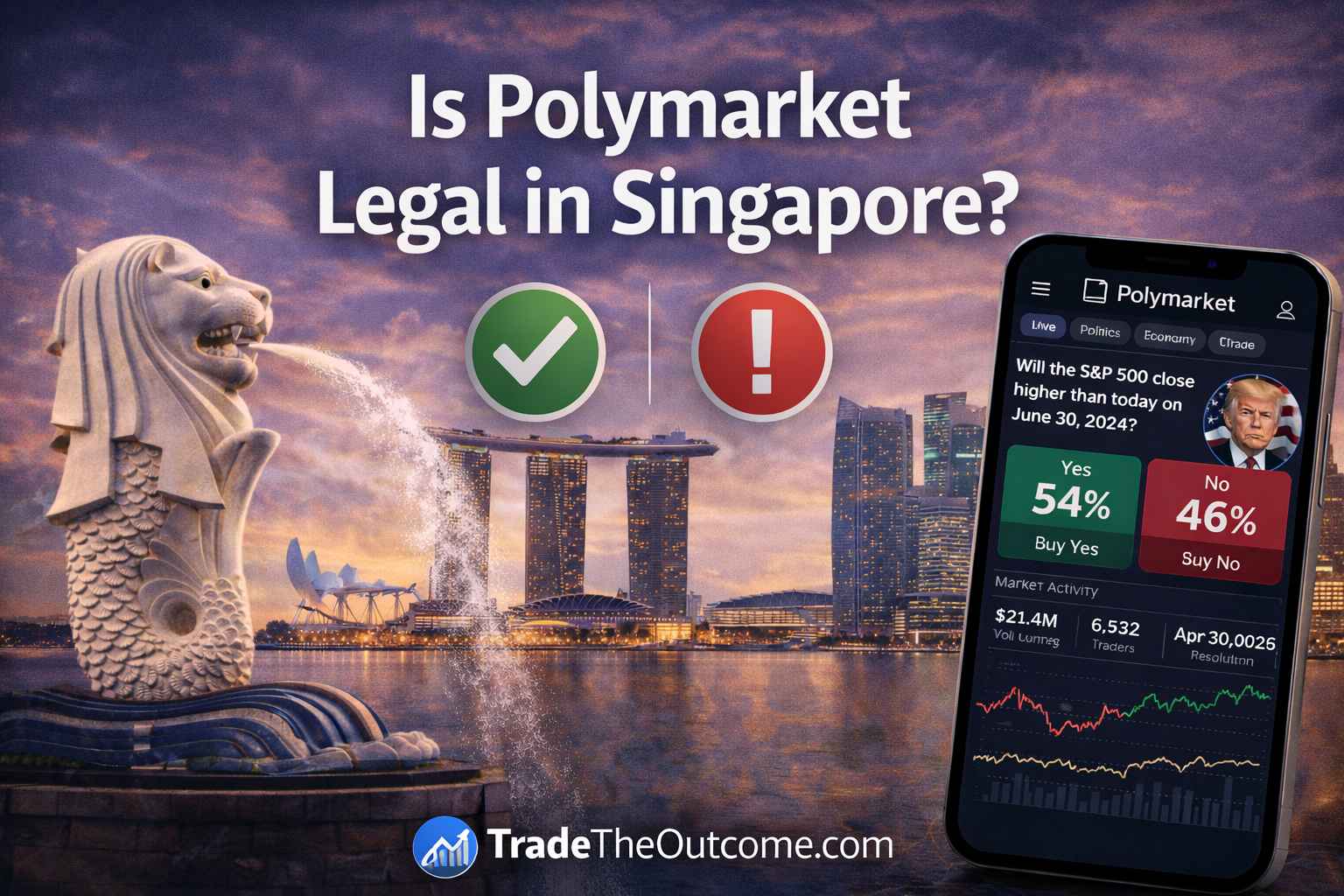
Polymarket is not legal in Singapore. On January 12, 2025, the Gambling Regulatory Authority (GRA) of Singapore officially declared Polymarket an illegal gambling site and ordered all local internet service providers to block access to the platform. Users who attempt to visit polymarket.com in Singapore are redirected to a GRA warning page.
This is not a grey area. Singapore classifies Polymarket as an unlicensed remote gambling service under the Gambling Control Act 2022 (GCA), and individual users face real criminal penalties for participation. If you are new to prediction markets and want to understand what the platform actually is before diving into the legal details, read our guide on what Polymarket is.
- The GRA blocked Polymarket on January 12, 2025 as part of a wider crackdown that has shut down over 3,800 gambling websites
- Individual users face fines of up to SGD 10,000 and up to six months imprisonment under Section 20(3) of the GCA
- Enforcement authority shifted to the Singapore Police Force on January 1, 2025, signalling active prosecution intent
- Bypassing the block with a VPN does not make usage legal under Singapore law
- The only legal online betting provider in Singapore is Singapore Pools, a state-owned entity
Why Singapore Banned Polymarket?
Singapore operates one of the strictest gambling regulatory regimes in Asia. The Gambling Control Act 2022 replaced the earlier Remote Gambling Act and consolidates all gambling regulation under a single national framework.
Any operator offering real-money wagering services to Singapore residents must hold a GRA license. Polymarket held no such license and had no pathway to obtain one, as the licensing framework is reserved exclusively for Singapore-incorporated, state-linked entities.
When Singapore users attempted to access Polymarket on January 12, 2025, they were met with a GRA warning notice stating: “It is unlawful for any person to provide unlicensed remote gambling services in or from Singapore, or from outside Singapore to persons situated in Singapore.” The GRA simultaneously instructed all local ISPs to implement DNS-level blocking on the domain, as reported by Finance Magnates.
How Polymarket’s Contracts Were Classified as Gambling
Polymarket allows users to stake USDC on binary outcomes of real-world events, with payouts determined by verified results. Singapore regulators evaluated this structure against the GCA’s definition of gambling, which covers any activity where a monetary stake is placed on an uncertain outcome for potential monetary reward.
The blockchain-based and decentralized nature of the platform provided no exemption. Singapore law applies based on who is being served, not where the operator is incorporated or how its infrastructure is built.
What the Penalties Mean for Singapore Users
The penalty structure under the Gambling Control Act 2022 is explicitly tiered and applies to users, operators, and intermediaries alike. Singapore Police have confirmed active enforcement operations, with 36 persons investigated for illegal online gambling activities in November 2025 alone.
- Individual users (Section 20(3) GCA): Fine up to SGD 10,000, imprisonment up to six months, or both
- Unlicensed operators: Fine up to SGD 500,000, imprisonment up to seven years
- Repeat operators: Fine up to SGD 700,000, imprisonment up to ten years
- Payment facilitators: Banks and payment processors are required to block transactions to unlicensed platforms
- Intermediaries: Platform hosts, wallet operators, and content distributors who knowingly facilitate unlawful gambling are also subject to GRA action
These are enforced penalties, not theoretical maximums. The Singapore Police Force assumed direct enforcement authority for illegal online gambling from January 1, 2025, a deliberate escalation signal from the government indicating stricter active prosecution going forward.
Does Singapore’s Crypto Regulation Create Any Exemption?
Singapore is a recognized global crypto hub. The Monetary Authority of Singapore (MAS) regulates digital asset service providers under the Payment Services Act 2019, and dozens of firms hold active MAS digital payment token licenses as of 2026. However, MAS crypto regulation and GRA gambling regulation operate as entirely separate frameworks.
The fact that Polymarket uses USDC as its currency and runs on the Polygon blockchain does not reclassify it as a financial product under MAS supervision. Singapore’s regulators have been explicit that the underlying technology used by a platform does not change its legal classification. If the activity constitutes gambling under the GCA, the crypto wrapper is irrelevant to the legal outcome.
This is consistent with the broader global regulatory trend in prediction markets, where jurisdictions are increasingly applying gambling law rather than financial services law to event contract platforms.
What About Decentralization as a Legal Defence?
Polymarket’s decentralized architecture has not provided legal protection in Singapore. The GCA applies to anyone using an unlicensed service, regardless of whether that service has a central operator.
Singapore courts have consistently applied activity-based legal tests, meaning the nature of the transaction determines its legality, not the corporate structure or technical infrastructure of the platform delivering it.
Singapore’s Broader Crackdown on Prediction Markets
Polymarket was not singled out in isolation. Since the GCA came into full effect, Singapore has blocked over 3,800 gambling websites and frozen SGD 37 million in transactions linked to unlicensed gambling services.
The Polymarket block is part of a coordinated national push, as covered by SBC News, that also targeted other blockchain-based betting platforms operating without local licenses.
Singapore’s approach mirrors actions taken by other jurisdictions. France, Taiwan, and Switzerland have all moved to restrict Polymarket under their respective gambling frameworks. Taiwan went further and prosecuted an individual for placing bets on political elections.
For a global overview of how regulators are approaching event contract platforms, the International Association of Gaming Regulators published a detailed comparative analysis in February 2026.
Can You Use Polymarket in Singapore With a VPN?
Technically, a VPN can bypass the DNS block placed on polymarket.com by Singapore ISPs. But it does not make usage legal. Singapore law is applied based on the physical location of the user, not the IP address of their connection.
Accessing a banned platform through a VPN is treated as continuation of unlawful activity under the GCA, not a separate technical workaround that falls outside the law’s scope.
There is also a platform-level risk separate from the legal issue. Polymarket’s own terms of service prohibit circumventing geo-restrictions, which means accounts flagged for VPN usage risk suspension and potential fund holds.
Before depositing on any platform from a restricted jurisdiction, understanding whether Polymarket can freeze your funds is essential reading.
Legal Alternatives for Singapore Residents
Singapore residents have very limited options for legal prediction-style trading within the country. Singapore Pools offers licensed sports betting and lottery products with a narrow market selection.
For those interested in financial speculation, MAS-licensed digital asset exchanges allow trading in crypto assets but do not offer event contract markets in the style of Polymarket.
For users evaluating prediction platforms available in other jurisdictions, our comparison of Polymarket vs Kalshi vs PredictIt covers key differences in regulatory status, market availability, and fees across the three major platforms.
If you want to model potential returns before committing to any position, our Polymarket payout calculator can help with pre-trade analysis. A well-defined Polymarket trading strategy is also worth studying regardless of jurisdiction, as it applies universally to how the platform’s markets are structured.
Frequently Asked Questions
Why did Singapore ban Polymarket?
Singapore classified Polymarket’s event contracts as real-money gambling under the Gambling Control Act 2022. The platform held no GRA license, and the licensing framework is reserved exclusively for Singapore-linked state entities. The GRA ordered DNS-level blocking on January 12, 2025, as part of a broader crackdown that has shut down over 3,800 unlicensed gambling sites.
Does using a VPN make Polymarket legal in Singapore?
No. Singapore law applies based on the physical location of the user, not the IP address used to access a platform. Bypassing DNS blocks via VPN is treated as a continuation of unlawful activity under the Gambling Control Act 2022, and the Singapore Police Force has direct enforcement authority over illegal online gambling since January 2025.
Who is legally allowed to offer online betting in Singapore?
Only Singapore Pools, a government-owned entity, holds a GRA license to offer online sports betting and lottery services to Singapore residents. Singapore Turf Club holds a separate exemption for horse racing betting. All other domestic and foreign operators are prohibited from serving Singapore residents without a GRA license.
