

Ali Khamenei was killed in a joint U.S.-Israeli airstrike on February 28, 2026, along with dozens of other Iranian officials. His son Mojtaba was elected Supreme Leader by the Assembly of Experts within weeks and has not made a public appearance since, a fact traders keep pricing into the leadership contracts below.
The war has cycled through at least three ceasefires and collapses since April, and the most recent escalation came in early September, when U.S. Central Command struck Iranian crude oil tankers in the Gulf of Oman and a Sept. 8-9 missile exchange reportedly burned through a large share of U.S. Patriot interceptor stock in the region.
That pattern, strike, brief calm, repeat, is what has kept these nine Iran contracts near the top of Polymarket’s volume rankings for months. Each works the same way: shares in an outcome trade between 0 and $1, the current price is the market’s implied probability, and every contract resolves against specific written criteria on its own page rather than general news coverage. None of the nine are available to U.S. persons under Polymarket’s current terms.
Where the Iran war markets stand right now
The war between the U.S., Israel, and Iran has been running since February 28, 2026, when a joint U.S.-Israeli airstrike killed Supreme Leader Ali Khamenei along with dozens of Iranian officials. His son, Mojtaba Khamenei, was elected Supreme Leader by the Assembly of Experts in March and has not appeared in public since, a detail traders keep pricing into the leadership contracts below.
Fighting has cycled through at least three ceasefires and collapses since April, with the most recent flare-up coming in early September, when U.S. Central Command struck Iranian crude oil tankers in the Gulf of Oman and a Sept. 8-9 missile exchange reportedly burned through a large share of U.S. Patriot interceptor stock in the region.
Al Jazeera’s live coverage of the conflict has run daily through early September, and that steady drumbeat of escalation is what’s kept the nine contracts below near the top of Polymarket’s Iran category by volume. Each works the same way: shares in an outcome trade between 0 and $1, the current price is the market’s implied probability, and every contract resolves against specific written criteria on its own page rather than general news coverage. None of them are available to U.S. persons under Polymarket’s current terms.
Kharg Island no longer under Iranian control
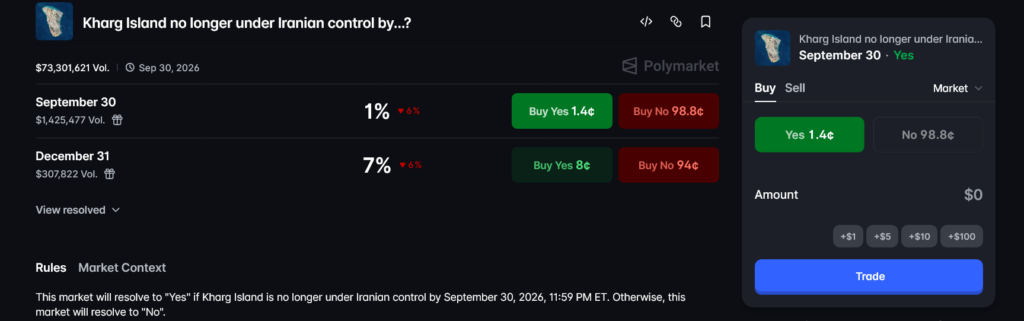
Kharg Island no longer under Iranian control is the single most-traded Iran contract on the platform, at over $70 million. It prices a change in control at just 7% by December 31 and 1% by September 30, despite repeated U.S. threats to target or seize the island, because occupying Iranian territory is a materially different and riskier act than striking it.
Kharg handles roughly 90% of Iran’s crude exports, which is why the contract’s resolution rules are unusually strict. Temporary raids, isolated landings, special operations, bombardment, and offshore naval presence explicitly do not qualify as a change in control on their own; the market only resolves “Yes” once actual, sustained control has been established and confirmed by official statements or a consensus of credible reporting.
Will the U.S. invade Iran before 2027
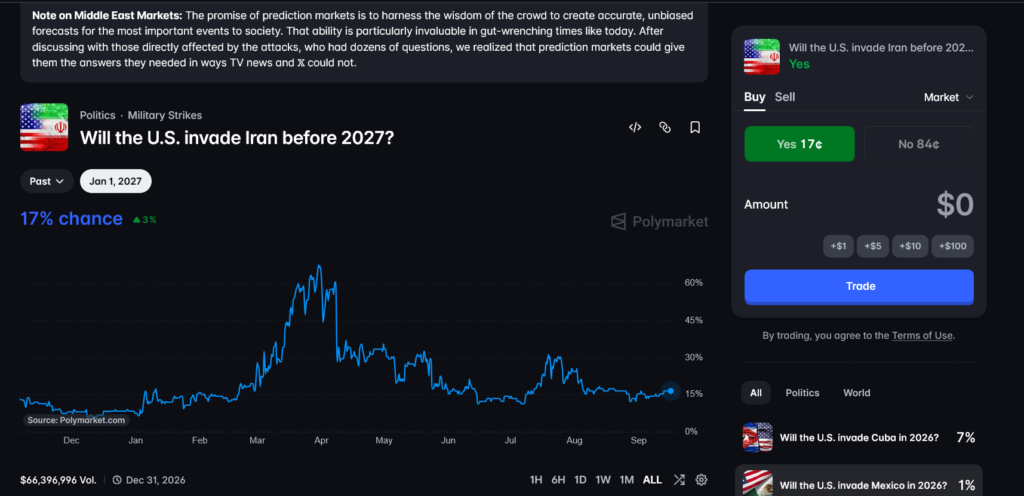
At 17%, Will the U.S. invade Iran before 2027 is the contract most likely to get misread by a casual reader. Seven months of strikes, a naval blockade, and tanker seizures already meet most people’s working definition of a war with Iran, but the market’s 17% is pricing something narrower: a full ground invasion, not the continuation of the current air and economic campaign.
President Trump has signaled he expects the conflict to wind down after the November midterms through an interim framework rather than an invasion, and internal U.S. discussions of a ground mission to seize nuclear material were reportedly paused over the risk of casualties and further escalation. Both details are consistent with where this contract is priced relative to the higher-probability contracts below it.
Iran leader end of 2026
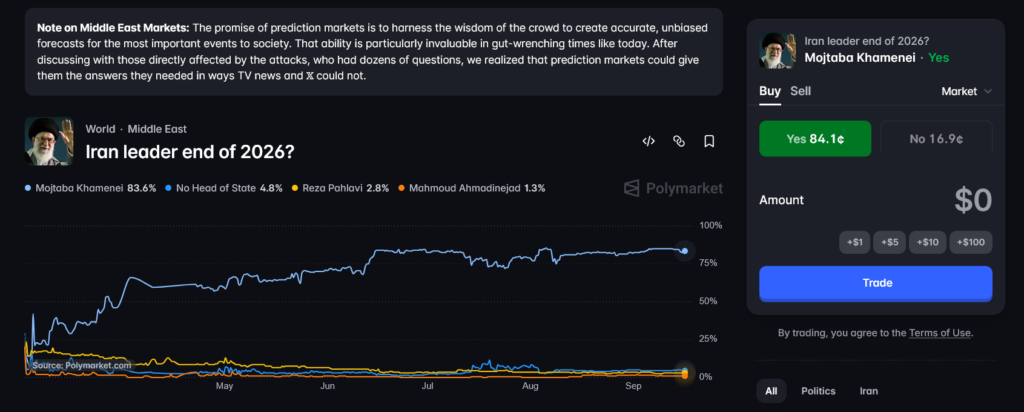
Iran leader end of 2026 has Mojtaba Khamenei at 84% to remain Iran’s de facto head of state through December, with “No Head of State” a distant second at 5%. The market has stayed in a narrow band for months, which traders are reading as confidence in the succession rather than certainty about Khamenei’s actual condition.
That confidence exists despite his continued absence from public view since taking office and a standing $10 million U.S. bounty for information on him. The contract’s resolution criteria require de facto governing authority, meaning control over the armed forces, executive ministries, and the capital, so a health scare alone would not flip this market without a visible break in that control.
Israel closes its airspace by Sept. 30
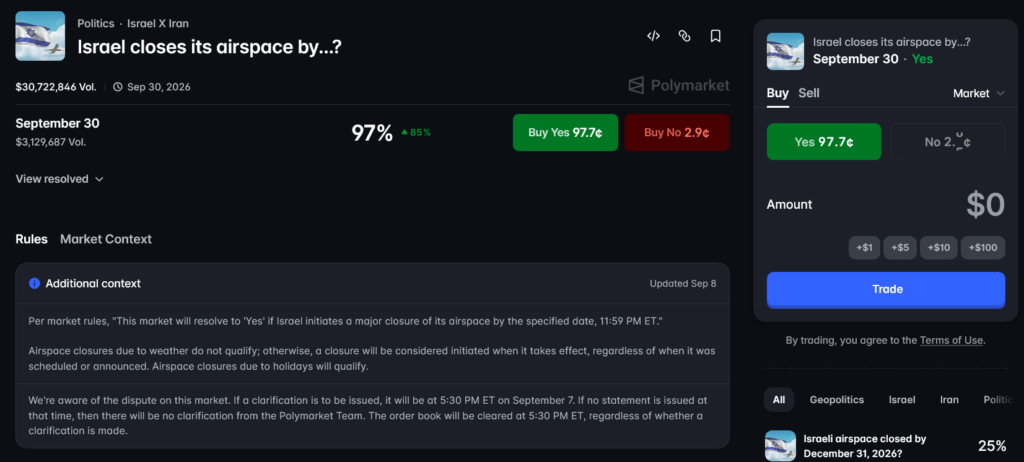
Israel’s airspace has stayed open through mid-September despite repeated closures and partial reopenings earlier in the year, but Israel closes its airspace by Sept. 30 has traded as high as 97% following the early-September tanker strikes and a fresh EASA advisory warning of missile and drone risk over Tel Aviv through the end of the month.
A scheduled Yom Kippur pause in commercial flights on September 20-21 will not count toward resolution, since the contract specifically requires a broad, security-driven closure of commercial aviation rather than a scheduled religious holiday shutdown. That distinction is worth knowing before assuming the holiday alone settles this market.
Israel x Iran ceasefire continues through
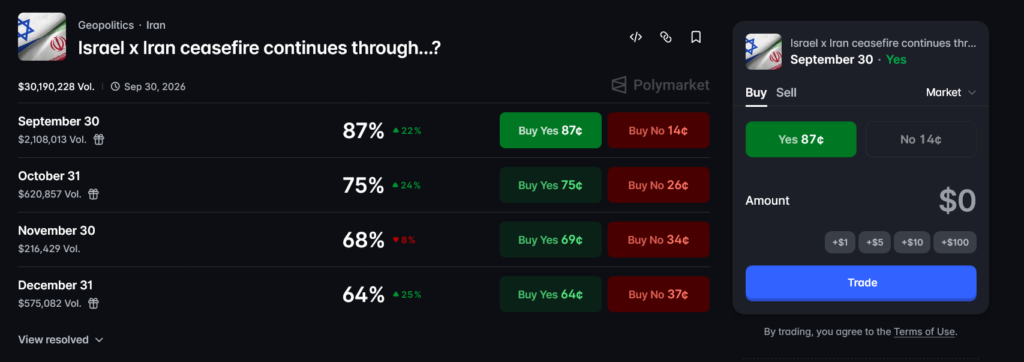
Israel x Iran ceasefire continues through is pricing 87% for the current truce holding to the end of September and 75% through October, a meaningfully lower number than the airspace contract above despite covering related ground. The gap reflects how often this specific ceasefire has already broken down and been renegotiated since the original truce in April.
Each prior collapse has followed the same pattern: a diplomatic breakthrough gets announced, holds for a matter of weeks, then breaks over an incident near the Strait of Hormuz or a strike one side calls a violation. Traders pricing 75% for a full extra month are effectively betting this cycle slows down rather than repeats on the same timeline.
US obtains Iranian enriched uranium
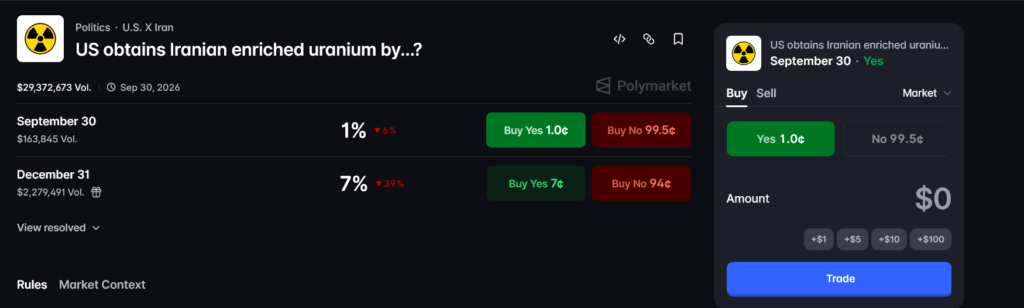
US obtains Iranian enriched uranium sits near the bottom of this list at 7% by December 31 and 1% by September 30. Reporting earlier this month indicated that internal U.S. plans for a ground mission to physically seize nuclear material were paused over the risk of casualties and further escalation, and this contract’s pricing tracks that reporting closely.
The low number also reflects how narrow the resolution bar is: air and missile strikes on enrichment sites, which have already happened repeatedly in this conflict, would not resolve this market “Yes” on their own. It requires actual U.S. custody of enriched material, a materially harder and more provocative act than destroying it in place.
US announces end of Iranian blockade
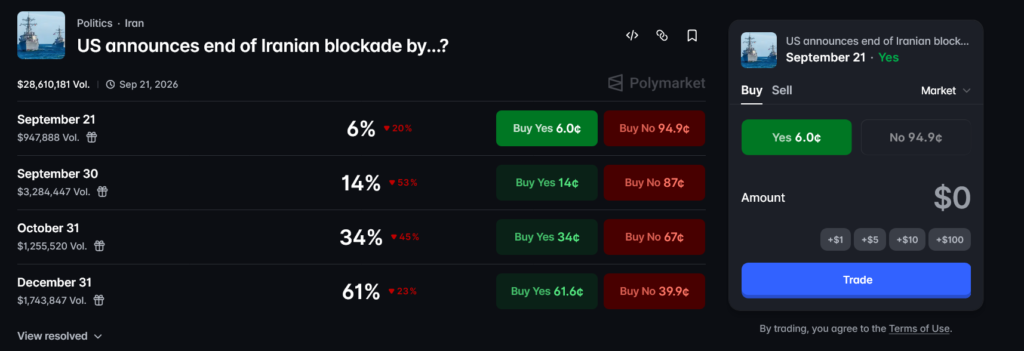
The US announces end of Iranian blockade contract, at 65% by December and 37% by October 31, is one of the more mispriced-looking numbers in this group. Defense Secretary Pete Hegseth stated in mid-August that the U.S. can maintain the naval blockade indefinitely, and Central Command has since confirmed the blockade persists even where mine-clearing operations in the Strait of Hormuz have finished.
The market’s pricing implies traders expect a political announcement well before that stated military posture changes, which is a bet on Washington’s domestic incentives as much as on conditions in the Gulf. A formal announcement carries political risk during a midterm cycle, and the resolution criteria require an actual public declaration, not just a quiet reduction in enforcement.
Will the Iranian regime fall before 2027
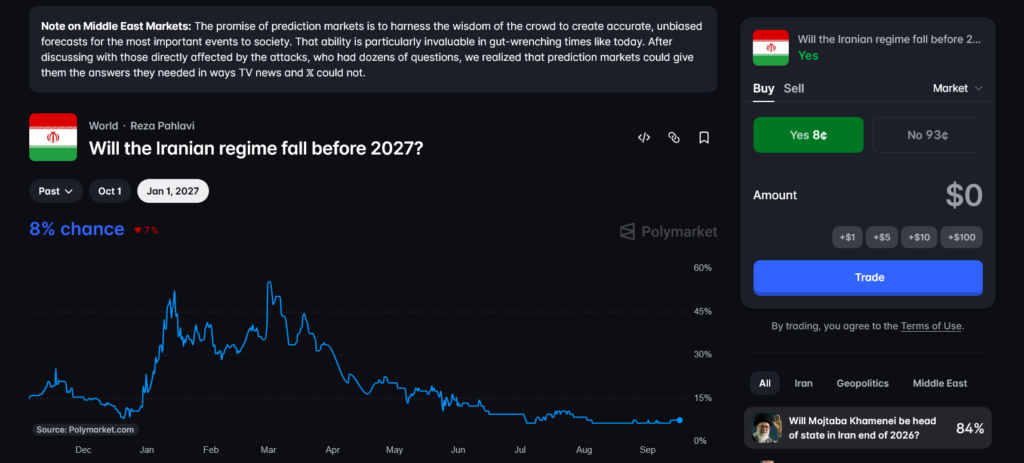
Will the Iranian regime fall before 2027 prices regime collapse at just 8%, the lowest of the political contracts in this group. The bar here is high by design: the market only resolves “Yes” if the Islamic Republic’s core institutions, including the Supreme Leader’s office, the Guardian Council, and IRGC control under clerical authority, are dissolved or replaced by a fundamentally different governing system.
Routine political events like elections, internal power struggles, or leadership succession explicitly do not qualify, which is why this number sits so far below the leadership-change contract that follows. Iran’s economy has contracted sharply and inflation has run well above 40% through the war, but that economic pressure has not translated into institutional collapse in the market’s pricing.
Iran leadership change
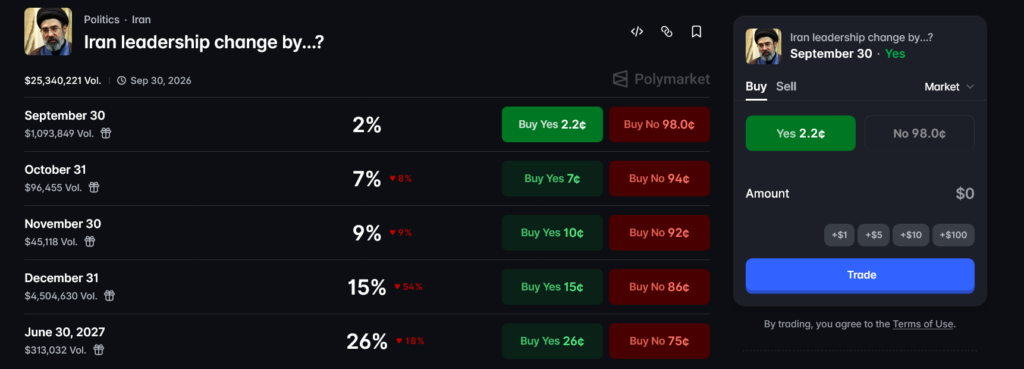
Iran leadership change prices a change by June 30, 2027 at 26% and by December 31 at 15%, more than three times the shorter-dated regime-collapse contract above. Our earlier deep dive on the odds of the Iranian regime collapsing outright covers why traders treat a change at the top and a full institutional collapse as very different bets.
This contract counts a broader set of outcomes than the regime-fall market, including an internal succession within the existing power structure if Mojtaba Khamenei’s continued absence forces one. That is the more plausible near-term risk traders are pricing, not a revolution or external overthrow.
Nine contracts, $345 million in combined volume, and not one of them is pricing a quick resolution. The market consensus right now is a war that keeps grinding through the fall without tipping into a full U.S. invasion or an Iranian regime collapse, and without a durable ceasefire either.
How to actually trade one of these
Every contract above works the same way. Shares in each outcome trade between 0 and $1, and the current price is the market’s implied probability of that outcome. Buying “Yes” on the Israel airspace contract at 97 cents means paying 97 cents for a share that pays out $1 if a qualifying closure happens by September 30, and nothing if it does not.
None of these contracts are available to U.S. persons under Polymarket’s current terms, and every market resolves on the specific written criteria published on its own page, not on general news coverage of the war.
A trader who reads only the headline number and skips the resolution rules is the most common way people lose money on contracts like Kharg Island’s, where “temporary raids” and “special operations” explicitly do not count as a change in control. For a broader look at position sizing and risk on contracts like these, see our Polymarket strategy guide for 2026.
What to watch through the end of September
The Yom Kippur flight pause on September 20-21 will generate headlines but should not move the airspace contract, since it is explicitly excluded from resolution. The more meaningful dates are any further CENTCOM statement on Strait of Hormuz mine-clearing, which has already moved the blockade contract by double digits once this quarter, and any State Department confirmation of direct talks, which traders are treating as the strongest leading indicator for the blockade market.
Nine contracts, $345 million in combined volume, and not one of them is pricing a quick resolution. The market consensus right now is a war that keeps grinding through the fall without tipping into a full U.S. invasion or an Iranian regime collapse, and without a durable ceasefire either.
