
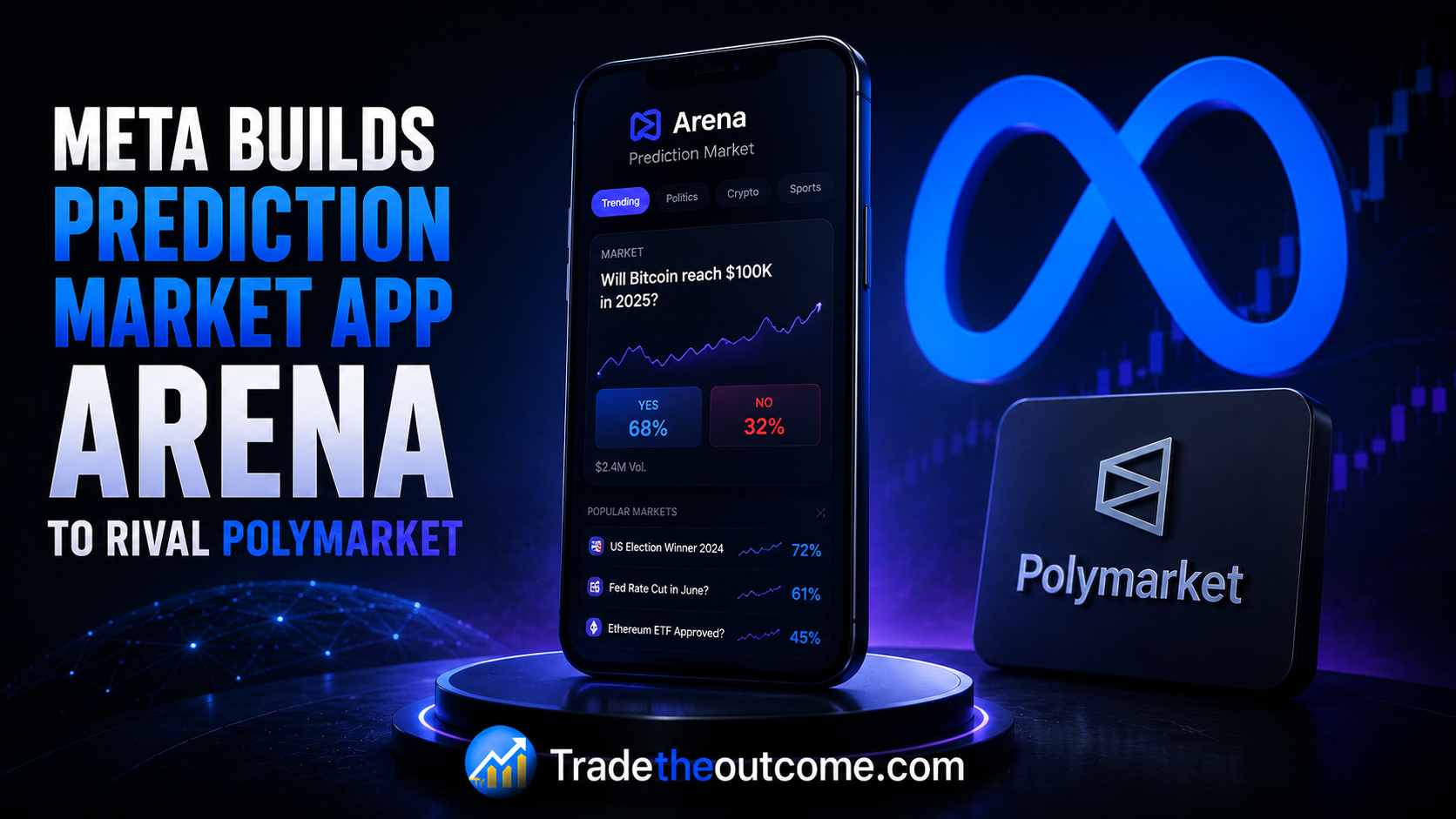
Meta CEO Mark Zuckerberg has directed a small internal team to build a prediction market app called Arena, the New York Times reported on June 23, putting 3 billion Facebook and Instagram monthly active users within reach of a sector where Polymarket and Kalshi combined are already clearing $24B in monthly trading volume.
The competitive landscape
Meta’s move landed immediately on the balance sheets of incumbent players. Shares of DraftKings and Flutter, both already under pressure from prediction market competition this year, declined after the Times report, with CNBC confirming the Arena development independently. Robinhood, which routes user order flow to Polymarket and Kalshi contracts, also fell on the news.
The sector Meta is entering has grown fast. Combined monthly trading volume across Polymarket and Kalshi rose from under $5B in September 2025 to $24B in April 2026, according to a Pew Research analysis cited by multiple outlets covering the report. As detailed in our prediction markets data and trends breakdown, much of that volume surge came directly from the 2024 US presidential election, which pushed prediction markets into mainstream consumer awareness for the first time.
Key competitive details as of June 23, 2026:
- Arena (Meta): Points-based system at launch, no real money, separate app, could receive traffic from Facebook and Instagram
- Polymarket: Crypto-settled binary contracts, open to non-US users globally
- Kalshi: CFTC-regulated, real-money event contracts for US users
- DraftKings Predictions: Real-money sports event contracts, stock down 37% YTD, and 2026 revenue guidance coming in below analyst consensus
The gap between DraftKings’ Predictions ambitions and its financial performance is the most useful data point for sizing the category’s difficulty: growing fast, but monetising slowly.
Driving factors
A second attempt at the same bet
Zuckerberg has run this play before. Meta launched a product called Forecast in 2020 that let users make predictions on current events. It shut down quietly in 2022. Arena is described by sources who spoke to the Times as “experimental but a top priority”, language that suggests Zuckerberg is personally committed in a way the 2020 version never was.
The Forecast post-mortem is worth keeping in mind: engagement products that don’t make money have historically struggled to retain users past the novelty phase.
The points architecture is a regulatory decision, not a product one
Arena is expected to use a video-game-style points system rather than real money, with Meta not ruling out real-money wagering in the future, according to the Times report confirmed by CNBC. That distinction is not cosmetic.
Real-money prediction markets in the United States fall under CFTC jurisdiction, the same regulatory framework that Kalshi has spent years and significant legal resources navigating, and that Polymarket has historically avoided by operating offshore.
A points-only product sidesteps federal oversight entirely and can launch on the App Store without regulatory approval. It is the fastest path to user adoption, and it costs Meta the monetisation layer that makes the category commercially interesting.
The regulatory context is moving simultaneously
The CFTC issued proposed rules on June 10, 2026, two weeks before the Arena report, that would ban event contracts tied to war, assassinations, and terrorism while potentially opening the door to legalized sports event contracts.
The rulemaking is ongoing, and the outcome will directly determine whether Meta’s “no real money for now” posture is a temporary workaround or a permanent ceiling. If the CFTC’s final rules create a clear US licensing path, Meta will face a decision: absorb the compliance cost and go for real-money volume, or leave that revenue to Kalshi and Robinhood while running Arena as a free engagement product.
The integrity of the underlying markets is also a live concern. Kalshi and Polymarket both announced new insider trading curbs in March 2026, following a DOJ charge against a Google engineer for using internal search data to profit on Polymarket, and a separate charge against a US soldier for trading on non-public information about Venezuelan political outcomes. Meta’s scale would amplify those risks considerably. A platform with access to billions of users’ behavioral data, building a market where information asymmetry determines profits, is a combination that regulators will not ignore.
The distribution argument cuts both ways
Meta’s 3 billion monthly active users are the headline advantage cited in every analysis of Arena’s potential. The comparison to Polymarket vs Kalshi liquidity and volume dynamics makes the distribution gap concrete: both platforms have grown rapidly but remain niche by any mass-consumer measure.
The counterargument is less discussed: prediction market accuracy depends on participants with genuine information and financial stakes. A points-based game on a social network skews participation toward casual entertainment rather than informed forecasting. If Arena fills up with users chasing points the way they chase Facebook likes, the market prices it generates will be noise rather than signal, and the product’s core value proposition collapses.
What to watch
The CFTC rulemaking that began June 10 has no fixed closing date, but comment periods for major proposed rules typically run 60 to 90 days, putting a response window somewhere in late August to mid-September 2026. If final rules clarify US event-contract legality before Arena launches, Meta will almost certainly face internal pressure to add real-money functionality; that decision will determine whether Arena is a growth threat to Polymarket and Kalshi or simply a larger version of what Forecast failed to be.
Meta has not confirmed a launch timeline. Prediction market participants should track whether Polymarket or Kalshi react to the Arena announcement with product changes, fee cuts, liquidity incentives, or API access expansions, as a leading indicator of how seriously the incumbents are taking the threat.
Market consensus on Arena’s implications is still forming. Whether the product launches as a points game or eventually as a regulated real-money platform will set the ceiling on how much of the existing prediction market user base it can actually absorb.
