

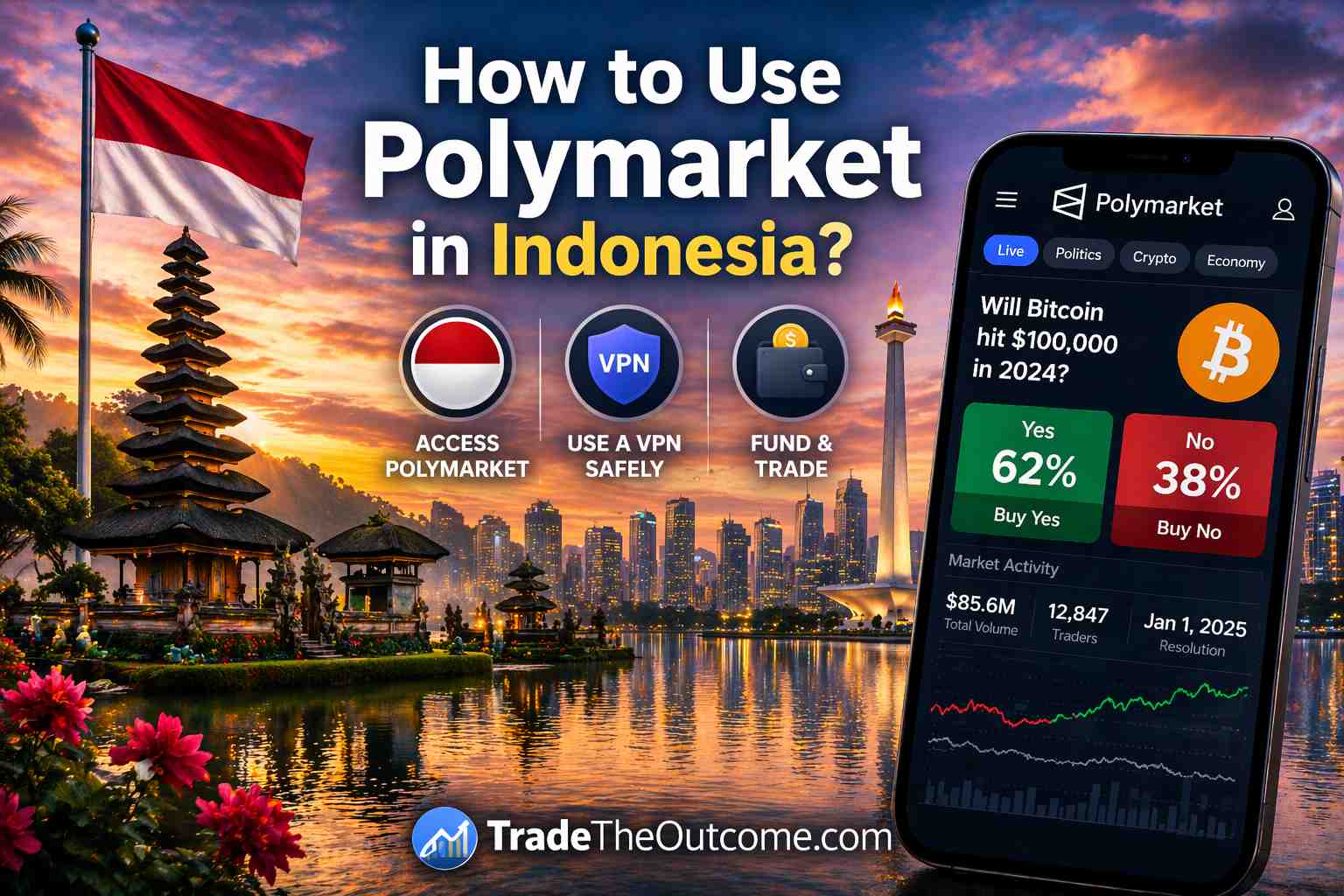
Polymarket is not officially geo-blocked in Indonesia as of April 2026, meaning Indonesian IP addresses can technically access the platform. However, Indonesia is running one of the most aggressive online gambling crackdowns in the world, having blocked over 1.3 million gambling-related websites and pieces of content between October 2024 and May 2025. The regulatory environment is hostile, and Polymarket could be targeted at any time without warning.
This guide covers the practical steps to use Polymarket in Indonesia alongside a clear-eyed view of the legal landscape. If you are new to prediction markets, start with our overview of what Polymarket is before proceeding. For the broader global regulatory picture, our prediction markets data and trends report provides useful context on how regulators worldwide are treating these platforms.
- Polymarket is not currently geo-blocked in Indonesia but is highly exposed to the country’s ongoing gambling crackdown
- Indonesia’s Komdigi Ministry blocked over 43,000 gambling-related digital items in the first week of 2025 alone
- Crypto trading is legal in Indonesia under OJK regulation, but using USDC as a payment instrument is technically prohibited under the Currency Law
- Gambling of any form is illegal under Indonesian law, with criminal penalties for participants
- You need a crypto wallet funded with USDC on Polygon to trade on Polymarket
Understanding the Legal Landscape in Indonesia
Indonesia operates under a strict anti-gambling legal framework rooted in both civil and Islamic law. All forms of gambling, online or offline, are explicitly prohibited under Article 303 of the Indonesian Criminal Code. Penalties for participation in illegal gambling include imprisonment of up to ten years and fines of up to IDR 25 million. There is no licensed online gambling sector in Indonesia and no pathway for any domestic or foreign operator to obtain one.
Online enforcement is handled primarily by the Ministry of Communication and Digital Affairs (Komdigi), which operates a proactive content blocking system. As Xinhua reported in May 2025, Indonesian authorities blocked more than 1.3 million gambling-related contents from October 2024 to May 2025, including websites, social media accounts, and advertisements. The initiative was directly prioritised by President Prabowo Subianto and Communication Minister Meutya Hafid as a national digital safety programme.
Is Polymarket Classified as Gambling in Indonesia?
No official classification of Polymarket by Indonesian authorities has been publicly announced as of April 2026. However, Polymarket’s event contracts, where users stake USDC on real-world outcomes, would likely fall under Indonesia’s broad gambling prohibition if examined by Komdigi.
The ministry does not require a formal court process to block a website; it can add domains to its blocklist administratively and instruct ISPs to implement DNS blocking within hours. Given that Indonesia blocked over 43,000 gambling items in the first six days of 2025 alone, the risk of Polymarket being added to the list without prior notice is real and non-trivial.
Crypto Regulation in Indonesia: What It Means for Polymarket Users
Indonesia’s crypto regulatory framework is separate from its gambling laws but creates its own complications for Polymarket users. As of January 10, 2025, regulatory oversight of crypto assets shifted from BAPPEBTI to the Financial Services Authority (OJK) under OJK Regulation No. 27 of 2024 (POJK 27/2024). Crypto is now classified as a regulated digital financial asset, and trading on OJK-licensed exchanges is fully legal.
However, using cryptocurrency, including USDC, as a means of payment is explicitly illegal under Indonesia’s Currency Law, which establishes the rupiah as the only legal tender. This creates a grey area for Polymarket specifically: depositing USDC into a prediction market and receiving USDC payouts could be interpreted as using crypto for payment transactions rather than purely investment trading, which falls outside what OJK regulation explicitly permits for retail users.
OJK-Licensed Exchanges vs Polymarket
Indonesian users who want legal crypto exposure must use OJK-licensed exchanges such as Indodax or Tokocrypto. These exchanges are regulated, KYC-compliant, and operate within Indonesia’s legal framework. Polymarket holds no OJK licence and does not fall under the OJK’s supervised entity list, meaning Indonesian users interact with it entirely outside the regulated financial system.
What You Need Before You Start
The practical steps for Indonesian users are the same as anywhere else. Polymarket runs on the Polygon blockchain and accepts only USDC as its trading currency. Before visiting the platform, make sure the following are in place.
- A crypto wallet: MetaMask (browser extension or mobile) is the most widely used and compatible option
- USDC on Polygon: The only accepted currency on Polymarket, always withdraw on the Polygon network, not Ethereum or BEP-20
- A government-issued ID: Indonesian KTP (national identity card) or passport for KYC verification
- A crypto exchange account: To purchase USDC, Binance and OKX are both accessible in Indonesia; domestic exchanges like Indodax may require an extra conversion step
- A VPN (optional but advisable): Given Indonesia’s active domain blocking, having a VPN ready ensures uninterrupted access if Polymarket is added to Komdigi’s blocklist
How to Use Polymarket in Indonesia: Step by Step
Follow these steps carefully. The most common mistake Indonesian users make is sending USDC over the wrong network, which results in inaccessible funds with no recovery pathway through a local regulator.
Step 1: Set Up MetaMask and Switch to Polygon
Download MetaMask as a browser extension for Chrome or as a mobile app. Create a new wallet and write your 12-word seed phrase down on paper and store it in a secure physical location, never digitally. Once your wallet is created, switch the active network from Ethereum Mainnet to Polygon. Polymarket operates exclusively on Polygon, and any funds sent over another network will not appear in your account.
Step 2: Purchase and Transfer USDC
Purchase USDC on Binance or OKX using your Indonesian bank account or preferred payment method. When withdrawing to MetaMask, select Polygon (MATIC network) as the withdrawal chain. Double-check your MetaMask wallet address before confirming. The Polygon network transaction typically confirms within 30 seconds to two minutes.
Step 3: Create Your Polymarket Account
Visit polymarket.com and click “Sign Up.” Connect directly with your MetaMask wallet for the fastest onboarding experience, this links your funds to the platform instantly without a separate deposit step. Indonesia is not currently on Polymarket’s official geo-block list, so the site loads normally from Indonesian IP addresses as of April 2026.
Step 4: Complete KYC Verification
Polymarket requires identity verification to unlock full withdrawal access. The KYC process involves uploading a government-issued ID (Indonesian KTP or passport) and completing a facial recognition scan. Approval typically takes between a few minutes and a few hours. Complete KYC early, unverified accounts face withdrawal restrictions that can delay fund access significantly.
Step 5: Browse Markets and Place Your First Trade
Once your wallet is connected and funded, your USDC balance appears directly on the Polymarket dashboard. Browse open markets by category, politics, economics, crypto, and sports are the most active sections. Select a market, choose a Yes or No position, enter your stake in USDC, and confirm the transaction in MetaMask. Review the trading fees and withdrawal options before depositing, and use our Polymarket payout calculator to estimate returns on any position before committing funds.
Key Risks for Indonesian Users
Indonesian users face a combination of platform-level, legal, and regulatory risks that are more acute than in most other accessible countries. Understanding whether Polymarket can freeze your funds is a key part of this risk picture, since no Indonesian authority can intervene if a dispute arises.
- Sudden blocking risk: Komdigi can add Polymarket to Indonesia’s DNS blocklist at any time without a court order or advance notice
- Criminal law exposure: Participation in online gambling is a criminal offence under Indonesia’s Criminal Code, with penalties of up to ten years imprisonment
- No OJK protection: Polymarket holds no OJK licence, meaning Indonesian consumer protection laws do not apply to your account or funds
- USDC payment restriction: Using USDC for staking and payouts may be interpreted as using crypto as a payment instrument, which is prohibited under Bank Indonesia’s Currency Law
- No local recourse: If funds are frozen or a market resolves incorrectly, there is no Indonesian regulatory body you can escalate to
Trading Smarter on Polymarket
If you proceed despite the risks, approaching Polymarket systematically significantly improves outcomes compared to ad-hoc trading. A structured Polymarket trading strategy focuses on identifying markets where the crowd-implied probability is mispriced relative to publicly available data rather than trading on intuition.
If you want to evaluate Polymarket against its main competitors before committing, our breakdown of Polymarket vs Kalshi vs PredictIt compares the three major prediction platforms on market availability, fees, and regulatory standing.
This article is for informational purposes only. TradeTheOutcome does not encourage or endorse using Polymarket in jurisdictions where gambling is illegal, including Indonesia.
Frequently Asked Questions
Is Polymarket blocked in Indonesia in 2026?
No, Polymarket is not currently on Indonesia’s official DNS blocklist as of April 2026. Indonesian IP addresses can access the platform directly. However, Indonesia’s Komdigi Ministry has blocked over 1.3 million gambling-related domains and contents since October 2024 and can add Polymarket to its blocklist at any time without a court order or advance notice.
Is online gambling legal in Indonesia?
No. All forms of gambling, online or offline, are illegal in Indonesia under Article 303 of the Criminal Code. There is no licensed online gambling sector, and no domestic or foreign operator can obtain a gambling licence. Penalties include imprisonment of up to ten years and fines of up to IDR 25 million for participants.
Can I buy USDC in Indonesia to use on Polymarket?
You can legally purchase USDC on OJK-licensed or internationally accessible exchanges like Binance and OKX from Indonesia, as crypto trading is legal under POJK 27/2024. However, using that USDC to stake in prediction markets could be interpreted as using crypto as a payment instrument, which is prohibited under Indonesia’s Currency Law enforced by Bank Indonesia.
Do I need a VPN to use Polymarket in Indonesia?
You do not need a VPN right now, as Polymarket is currently accessible from Indonesian IP addresses. However, given Indonesia’s active and unpredictable domain blocking programme, having a VPN ready is advisable. If Komdigi adds Polymarket to its blocklist, access will be cut off at the ISP level with no advance warning to users.
